Dear readers,
We are proud to announce our third issue of the Youth Science
Journal! We would like to thank all our readers for their
support and feedback to improve our upcoming publishes. We
also hope you enjoy reading this issue as our issue’s theme is
Biotechnology/Biomedical Engineering! There are a lot of
remarkable articles in this issue, covering from bionic eyes
to DNA sequencing. You may notice that our format is different
this issue. We have changed it to fit our needs and be easier
for writers.
Furthermore, we are excited to announce that 16 extraordinary
students from different high schools are now part of our
writers’ crew! We have been on hiatus for the past months,
conducting training sessions for them by the senior writers.
Now, they are ready to publish their articles in our upcoming
issues. So, stay tuned!
However, if you were not able to join our team, we are very
proud to announce that the Youth Science Journal is open for
publication! You can now publish your article on our website
about any topic in science through:
www.ys-journal.com/publish. Publishing a review article about
a specific topic will not only let you learn about it more,
but also share awareness for that topic! All you have to do is
to make sure that your article is following our guidelines
that are available on our website. We have already started
accepting articles and we would like to thank Ziad Khaled for
being the first to publish onto our journal!
Best Regards,
Youth Science Journal Community
Table of Contents
Issue 3
Issue 3
January 2021
Letter from the Journal
Bionic Eyes: the definitive solution for visually impaired individuals?
Abstract
Once a topic of folklore and science fiction, the notion of
retaining vision to the blind is now much closer to becoming
a reality than it ever was before. As the rise of
microelectronics and microfabrication has given way to
drastic improvements in the field of prosthetic devices. the
developing technology has given rise to a plethora of
approaches and designs to achieve said purpose. yet these
visual prosthetics operate on the same premise: relying on
intact neural circuitry whenever possible in order to take
advantage of any intact sensory processing available
I. Introduction
Unlike what many would assume, Prosthetic eyes have, in fact, long been in development, with succeeding irritations improving using more microelectrodes that mimic the function of photoreceptors in the human cornea. The Argus II, for example, is the second generation of a prosthetic retinal implant with the goal of vision restoration for patients diagnosed with Retinitis pigmentosa. The implant study was first initiated back in 2002 in which implantation in six patients in the trial proved to be successful. The implant has proven that the device has the potential to allow legally blind patients to detect light, and possibly distinguish between objects. The device is basically meant to take place of photoreceptors. However, the use of only 16 electrodes in first-generation devices was the most limiting factor in terms of vision fidelity. And henceforth the Argus II comprised 60 electrodes providing higher resolution images. The new device is approximately one-quarter the size of the original device, reducing surgery and recovery times by a significant margin.
II. Mechanism
In its very essence, the retina is merely a matrix of nerve cells firing signals upon being struck by lights of specific wavelengths and degrees. These neurons then send an electrical signal to the brain’s visual cortex in which color, light intensity, edges, and more information are processed to try and work out what the person is seeing. This processing part, in fact, does not simply translate these electrical signals into images interpretable by the human but rather edits out what may be irrelevant and focuses on the more significant pieces of the image such as motion: an incredible process in the very least. Obviously, vision involves much more complexity than is shown, but this complexity is beyond the scope of this paper. Our primary focus here is to make it clear how a prosthetic eye could manipulate this system in order to produce comprehensible images. The bioniceye can be viewed as a replacement for a retina that can no longer perform this function.
III. Improving Vision Quality
Several approaches have been devised to improve vision quality. The most obvious of which was to increase the number of implanted electrodes, allowing them to target certain neurons accounting for more pixels and thus better resolutions. However, normal sized-micro electrodes would not fit in such a confined space. For that reason, attempts at shrinking the size of the microelectrodes have been made [2]. By electrically stimulating retinal ganglion cells using thousands of microscale nitrogen-doped ultra-nanocrystalline diamond (N-UNCD) feedthroughs that act as electrodes. Aside from the expensiveness of the diamond coating, the use of such technology has not yet proven feasible and requires further research. Another technique is to artificially increase the resolution by sharing electrical current between electrodes, producing additional “virtual electrodes”. These new techniques can possibly improve visual fidelity, reduce blurriness, and give rudimentary control over color: a distinctive feature of natural eyesight. The ultimate goal would be to fully understand the code sent from the retina to the brain. Theoretically, If the firing patterns of the receptors can be replicated, vision will appear exactly as perceived by a healthy individual’s eye.
IV. The Future of Bionic Eyes
Taking the technology to the next level, there is a possibility to go beyond what a normal human eye could do. Once the code between the retina and the brain has been deciphered, there would be an unlimited potential for the technology from the ability to see infra-red, night vision, or x-ray. To magnifying images naturally, running software that processes images, blocking out bright sunlight, and substituting sunglasses. In fact, being able to watch a movie, scrolling through your newsfeed, or even playing a simple video game, seems equally plausible using the same technology that could, theoretically, help the blind see again.
V. Conclusion
Undoubtedly, the goal of restoring some degree of vision to the blind using bionic eyes certainly seems feasible, but providing them with fully detailed vision like that of healthy individuals while seemingly plausible with the progress the technology is seeing and with its technological challenges continuing to be solved, it is questionable whether these individuals will be able to fully interpret the images processed in the brain, and understand features like their depth, edges, and advanced details like color. Casting further doubt on the subject matter, it is yet to be understood how the brain of a once visually impaired individual would react to perceiving light once again and whether that would influence the recovery speed. Rehabilitation is certainly going to be needed for a successful recovery. Furthermore, this technology shows no potential for treating cognitive blindness, and it is unlikely to be cured in the next decade. While the bionic eye does not yet seem to be a definitive solution for the blind. There is certain ground to be optimistic about the technology. What is now clear is that the feasibility of this technology is dependent on the mandatory collaboration between physicians, doctors, and scientists from different fields.
VI. References
Genetically Modified Organisms
Abstract Genetically Modified Organisms have been around two decades, and they areconsidered safe for human, but on the other side, other studies show that GMO have some risks and deleterious effects on animals, GM food just like any new drug requires many tests to prove that these new organisms are safe for human and can exist in the markets. Ongoing independent studies to evaluate safety are needed. Scientific, economic, environmental, social, ethical, and political perspectives will need to be considered.
I. Introduction
Genetically Modified Organisms (GMO) are organisms whose
genetic information (DNA) has been changed by inserting a
gene from another organism to give specific functions that
it cannot do before this technique called “modern
biotechnology” or “gene technology”, which improve the
yield through introducing resistance to plant diseases or
of increased tolerance of herbicides, GMO can also allow
for reductions in food prices through improved yields and
reliability
II. How does the process of genetic engineering happen?
i. DNA isolation:
The needed gene is determined then they isolate the DNA from the organism that contains this gene by breaking the cell structure and this often happens physically by smashing the organism y, then protease (protein enzyme) is added to degrade DNA-associated proteins and other cellular proteins. After that the DNA separate by adding alcohol by this process all the cell material precipitate while the DNA become at the top and it will appear like white cotton.
ii. Use the plasmid as a vector:
A restriction enzyme is DNA-cutting enzymes. Each enzyme recognizes one or a few target sequences and cuts DNA at or near those sequences, this enzyme used to cut a specific sequence from the gene that has the needed treat, then the same restriction enzyme is used to cut the plasmid which is used as a vector to enter the gene to the organism, then the plasmid inter the organism by using a gene gun. After this process the cell will contain the foreign gene and when the cell division accrues the new daughter cells will contain this gene.
III. What are the benefits of GMOs?
GM foods are developed because of some perceived benefits to the producers and the consumers The World Health Organization (WHO) and the United States Department of Agriculture (USDA) have outlined a comprehensive list of thebenefits of GM foods. This list is discussed below.
i. Insect resistance:
Agricultural biotechnology has been used to make the plants insect resistant, this is achieved by introducing the gene of a toxin called Bacillus thuringeinsis come from BT Bactria, this toxin is considered for humans and it currently uses as an insecticide, the plants that uptake this gene becomeresistance against borer insects. This technology makes the crop requires lower quantities of external insecticides. Such genetic modification can make crop production cheaper and more manageable, as well as make pest control safer. Additionally, there isdecreased contamination of the groundwater and the environment from pesticides.
ii. Disease Resistance:
Some diseases can be resisted by using genetic
modification organisms, as these crops resist some
diseases better than the normal crops
iii. Nutritional:
Some GMO can produce nutritionally enriched plants, as these organisms are uptake gene that will produce specific vitamin like golden rice, this rice is uptake biosynthesize beta-carotene gene, which is not normally produced in rice. The beta carotene gene is converted into Vitamin A when it is metabolized by the human body. Vitamin A is essential for healthier skin, immune systems, and vision.
IV. What are the risks of GMOs?
The world health organism has identified three main risks for the genetic modification organisms which are discussed below.
i. Allergenicity:
Some GM foods have the potential to cause allergic
reactions, as the gene that is transferred to the food
have the potential to cause allergic reactions, also
another risk is introduced a new gene to the food that did
not previously exist in the food chain
ii. Gene transfer:
Another risk for GMOs is the transfer of genetic material
from the GM food to the human cells, the DNA that comes
from GM food is not completely digested by the digestion
system and small fragments of the DNA have been found in
different parts of the gastrointestinal tract
iii. Outcrossing:
Outcrossing means that the genes of GM foods move to the
natural plants or the related species, this could make
other plants uptake unwanted genes that could cause health
problems to the human and damage the plant itself
V. Conclusion
GM food has numerous potential risks and benefits, many
studies have shown positive and negative results for GM
food. GM food has positive impacts on health, economic,
environmental, and social. Corn is extensively used in
processed foods and animal feeds, and GM corn now makes up
almost the entire U.S. crop. GM soybeans are not far
behind
VI. References
DNA Sequencing evolution
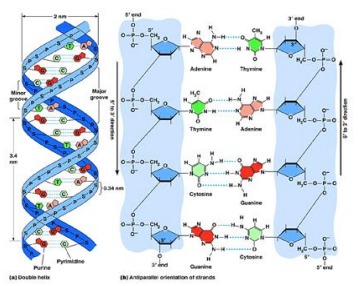
Abstract The genetic code is a universal language present in all known living organisms. The sequence of the four bases (adenine guanine thymine and cytosine) determines the genotype and phenotype of a living being. DNA sequencing can be used to determine the nucleotide sequence of specific genes, larger genetic regions, whole chromosomes, or the entire genome of an organism. Knowing this helps scientists answer fundamental biological questions about evolution and how life works. Known genomes in humans can be scanned for diseases and plants modified to create GM crops that are resistant to pests or have a higher yield. This technology is crucial to all genetic engineering. This article will cover the evolution of DNA Sequencing and explain the complete procedure of two of the most common methods of sequencing DNA, Sanger sequencing as well as next-generation sequencing.
I. Introduction
II. The invention of DNA Sequencing
Early attempts to sequence DNA were unwieldy. In 1968, Wu
and Kaiser reported the utilization of primer extension
methods to work out 12 bases of the cohesive ends of
bacteriophage lambda
III. Dideoxy Chain Termination Method for Sequencing DNA Todo!!!!!!!!!!!!!!!!!! -> Figure Caption
Sanger sequencing, also referred to as chain-termination sequencing, refers to a way of DNA sequencing developed by Sanger in 1977 (Figure 2). This method is predicated on the synthesis of a nested set of DNA strands complementary to one strand of a DNA fragment. Each new strand starts with an equivalent primer and ends with a dideoxy ribonucleotide (ddNTP), a modified deoxyribonucleotide (dNTP). The incorporation of a ddNTP terminates a growing DNA strand because it lacks a 3’ OH group, the location for attachment of subsequent nucleotide. within the set of latest strands, each nucleotide position along the first sequence is represented by strands ending at that time with the complementary ddNTP.
Procedure
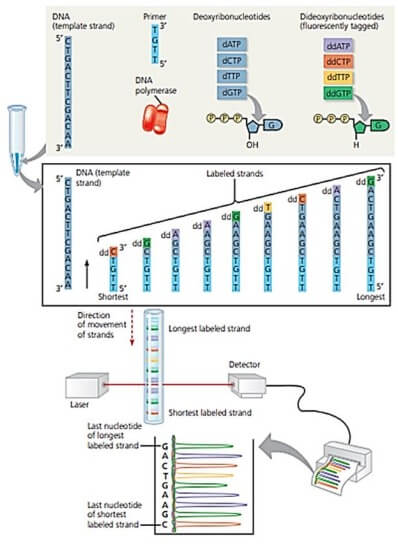
- The fragment of DNA to be sequenced is denatured into single strands and incubated in a test tube with the necessary ingredients for DNA synthesis
- Synthesis of each new strand starts at the 3′ end of the primer and continues until a ddNTP happens to be inserted instead of the equivalent dNTP. The incorporated ddNTP prevents further elongation of the strand. Eventually, a set of labeled strands of every possible length is generated, with the color of the tag representing the last nucleotide in the sequence.
- The labeled strands in the mixture are separated by passage through a gel that allows shorter strands to move through more quickly than longer ones. For DNA sequencing, the gel is in a capillary tube, and its small diameter allows a fluorescence detector to sense the color of each fluorescent tag as the strands come through. Strands differing in length by as little as one nucleotide can be distinguished from each other.
IV. Next-Generation Sequencing
The main difference between NGS (Figure 3) and Sanger
sequencing is the construction of the sequencing library.
Sanger sequencing libraries need multiple steps that
combine molecular biology with microbiological culture to
represent the DNA sample of interest as a series of
subclones in a bacterial plasmid or phage vector. These
subclones then need growth in culture and DNA isolation
before sequencing. This multistep process can be completed
in approximately one week, at which point the purified
DNAs are ready for sequencing
Procedure
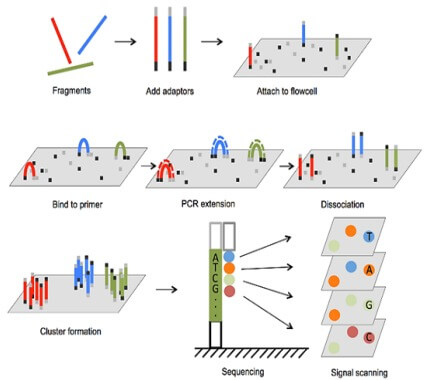
- Genomic DNA is fragmented, and fragments of 400 to 1,000 base pairs are selected.
- Each fragment is isolated with a bead in a droplet of aqueous solution.
- The fragment is copied over and over by a technique called PCR (to be described later). All the 5′ ends of one strand are specifically” captured” by the bead. Eventually, 106 identical copies of the same single strand, which will be used as a template strand, are attached to the bead.
- The bead is placed into a small well along with DNA polymerases and primers that can hybridize to the 3′ end of the single (template) strand.
- The well is one of 2 million on a multiwell plate, each containing a different DNA fragment to be sequenced. A solution of one of the four nucleotides is added to all wells and then washed off. This is done sequentially for all four nucleotides: dATP, dTTP, dGTP, and then dCTP. The entire process is then repeated.
- In each well, if the next base on the template strand (T in this example) is complementary to the added nucleotide (A, here), the nucleotide is joined to the growing strand, releasing PPi, which causes a flash of light that is recorded.
- The nucleotide is washed off and a different nucleotide (dTTP, here) is added. If the nucleotide is not complementary to the next template base (G, here), it is not joined to the strand and there is no flash.
- The process of adding and washing off the four nucleotides is repeated until every fragment has a complete complementary strand. The pattern of flashes reveals the sequence of the original fragment in each well.
V. Conclusion
Improved DNA sequencing techniques have transformed the
way in which we can explore fundamental biological
questions about evolution and how life works. Little more
than a decade after the human genome sequence was
announced, researchers had completed sequencing roughly
4,000 bacterial, 190 archaeal, and 180 eukaryotic genomes,
with more than 17,000 additional species underway
References
Brain-Machine Interface: Review of Current State and Clinical Applications
Abstract Brain-machine interface (BMI) is a novel device that allows the translation of brain activity like action potentials in the neurons into commands and data that can be processed by machines and used. In the hope of helping neuromuscular patients with their severe disabilities, research has rapidly increased on BMIs in the past decade and a half. BMIs have been demonstrated to control robotic limbs, wheelchairs, computer cursors, and even allowed patients that are unable to talk to synthesize speech through them. In this review article, BMIs will be reviewed from its definition to the different types, invasive or noninvasive
I. Introduction
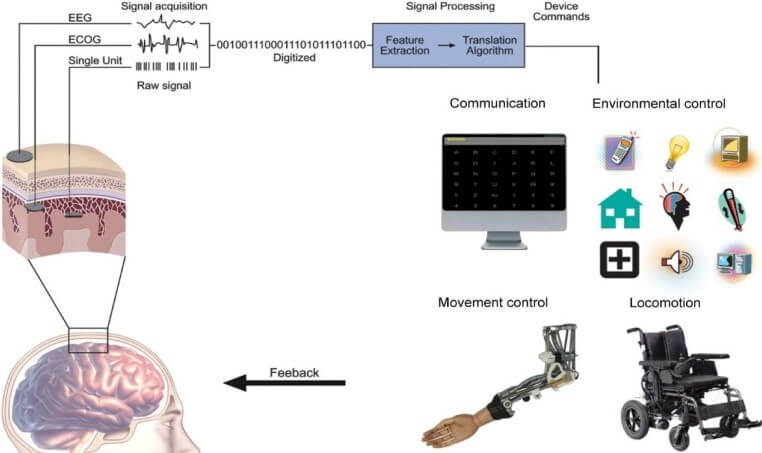
Brain-Machine Interfaces (BMIs) are novel devices that
allow the translation of brain activity in terms of
electric activity on the cortical surface of the brain,
allowing the user to communicate with machines without
moving peripheral nerves and muscles
II. Noninvasive and Invasive BMIs
BMIs are also divided into two types: non-invasive and
invasive. Non-invasive BMIs depend on
electroencephalography (EEG) to detect electrical activity
in the brain
III. Brain Signals Detectable by Noninvasive BMIs
Non-invasive BMIs detect seven types of signals: slow cortical potentials (SCP), sensorimotor rhythms, P300 event-related potential, steady-state visual evoked potentials, error-related negative evoked potentials, blood oxygenation level and cerebral oxygenation changes.
i. Slow Cortical Potentials (SCP)
Slow cortical potentials are the occurrence of cortical
polarization, which can be easily recorded using direct
amplifiers from any location on the scalp
ii. Mu and beta rhythms
Mu and beta rhythms from somatosensory cortexsinusoidal
frequencies in ranges 8-13 Hz that are detected by BMIs at
the somatosensory and motor cortical regions
iii. P300 event-related potential
When the somatosensory cortex gets activated through
significant auditory, visual, or any stimuli, it typically
evokes the non-invasive BMI over the parietal cortex at
about 300 milliseconds
iv. Steady-state visual evoked potential (SSVEP)
Steady-state visual evoked potentials are signals evoked
from the occipital cortex during the occurrence of
periodic presentation of visual stimuli of 6 hertz
v. Error-related negative evoked potentials (ERNP)
ERNPs occur 200-250 miliseconds after “the detection of
an erroneous response in a continuous stimulus-response
sequence
vi. Blood Oxygenation Level
This type of BMI doesn’t depend on EEGs but instead of
functional MRIs. Blood oxygen level-dependent fMRI detects
the metabolic activity in the brain, which represent the
changes in neural activity
vii. Cerebral oxygenation changes
Near Infrared spectroscopy (NIRS) is an spectroscopic
technique that measures light absorbance to calculate
oxy-HB and deoxy-HB, which provides insight of brain
activity
IV. Signal Acquisition
Signal acquisition is basically the measurement of the
neurophysiologic state of the brain, where the BMI is
tracking the aforementioned signals in the brain
V. Feature Extraction
The first step of signal processing is feature
extraction, which is the extraction of main changes in
signals that are encoding the intent of the user
VI. Decoding of brain signals
After the BMIs extract the features of the signal, either
invasive or non-invasive, computational algorithms are
employed to translate these neuronal activities for direct
communication with the brain
VII. Device Output
After signal acquisition, feature extraction and going
through decoding algorithms, the signal is then passed
through its final phase, which is the translation of that
signal into an action. This action could be the selection
of words through a computer screen
VIII. Conclusion
Full recovery for patients with motor progressive
diseases, as of right now, is not possible, as diseases
like amyotrophic lateral sclerosis (ALS), Parkinson’s
disease, multiple sclerosis still don’t have viable
treatments that can stop the progression of them
IX. References
Link copied to clipboard!