Dear readers,
We are incredibly proud to finally release the first issue of
the youth science journal! We also hope you enjoy reading it.
We greatly appreciate that you take the time to read through
the articles and share your feedback with us.
For our team of incredible writers, it has been inarguably a
remarkable experience to research these scientific topics and
write about them in the articles. Writing this issue has
allowed us to delve deeper into our favorite fields of study
and deepen our knowledge about it. We let ourselves research
topics that we love in various fields of science in the
beginning and gradually chose to write about certain topics we
wanted to delve into more. During the process of writing, we
faced a lot of setbacks in the sense that the sources we were
using were too complicated or incomprehensive to us, high
school students. However, by the end, we were extremely
satisfied with the result and how it turned out. To deliver
this product, we utilized a relatively simple yet professional
rubric for the articles that let us keep the articles easily
comprehensible for high school students but, at the same time,
scientific and formal. In addition, the subjects of each
article were initially pre-determined, but we found that
method limited us significantly as it didn’t let us to fully
explore our favorite fields of study. Therefore, we kept the
subjects of each article up to the writers. We also found that
when we wrote about our favorite field of study allowed us to
output a higher caliber of work.
This issue goes from various subjects from neuroscience to
computer science and psychology. Highlights include an
in-depth review of a neurological condition, how could AI be
used in future pandemics, and history of IQ tests. Even though
we are highly proud of this issue, we still hope to improve
the next issues significantly by partnering with undergraduate
students and doctorates to peer-review our articles and make
sure that all our articles are scientifically correct. We’d
also like to review other deeper topics in the fields of
science.
If you have any questions or would like to contact us, please
do from our official website
https://www.ys-journal.com/contact
or email us at
ysciencejournal@gmail.com!
Best Regards,
Gasser Mamdouh (Chairman)
Moemen Wael (Vice-Chairman)
Saif Taher (Vice-Chairman)
Table of Contents
Issue 1
Issue 1
July 2020
Letter from the Chairmen
Life with No Pain: Congenital Insensitivity to Pain
Abstract Pain is mostly associated with unpleasant feelings and is largely despised and feared due to the emotional distress of sensations. However, without pain, humans wouldn’t be able to separate harmful actions from non-harmful ones and wouldn’t let their bodies heal. The sensation of pain is very crucial to the human body as it acts as a defense mechanism by alerting the body of on-going damage to the tissue or potential damage. The importance of pain is even more obvious when diagnosing patients with congenital insensitivity to pain, as their life is filled with terror of being hurt but being unable to detect it, which could ultimately lead to their death. This article dives into this disorder and how it can affect the normal daily lives of human beings, further revealing the vital importance of pain.
Background
According to the International Association for the Study
of Pain, “Pain is an unpleasant sensory and emotional
experience associated with actual or potential tissue
damage, or described in terms of such damage." It is very
vital that scientists started considering it as ‘the sixth
sense’
Mechanism
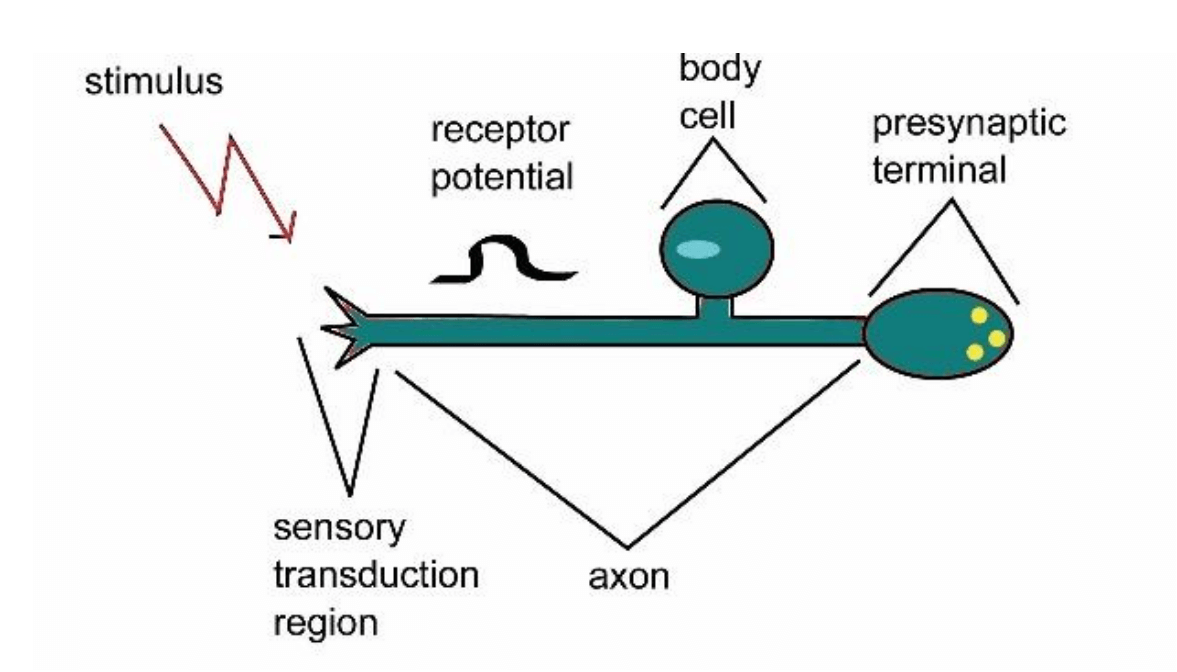
Pain occurs when special fibers called nociceptors
respond to stimuli that can potentially cause tissue
damage. Nociceptors are different from the usual neurons
as they have a cell-like body with a peripheral axon and
an ending that responds to diverse stimuli and is
additionally the transmitter of the pain-related
information to the central nervous system as shown in
figure 1
Life with No Pain?
Congenital Insensitivity to Pain (CIP), is a hereditary
disorder where a person is not able to perceive any
physical pain from birth. However, they can still feel
touch and differentiate between sharp and dull objects,
and hot and cold. On the other hand, they can’t sense if a
hot object is burning their body. As described before, one
of the most essential functions of pain is teaching the
human brain that doing this action again might injure the
body. Hence, patients with CIP cannot comprehend if
certain actions are dangerous or not, it leads to the
accumulation of wounds and broken bones due to a lack of
awareness of the danger and not expressing any discomfort.
This ultimately decreases these patients’ life expectancy.
Most people born with this condition die during their
childhood as they often do not realize their fatal
injuries, such as broken bones until it is too late
References
Is intelligence inherited: A brief history of IQ test and what makes us smart
Abstract Intelligence and how it is perceived was always a matter of debate throughout history. Several hypotheses gave the genes the lion’s share of one’s intelligence while others accounted for the high intelligence of someone to its education, environment, and even his mother’s womb. On the other hand, other opinions see that someone’s intelligence isn’t even measurable and that IQ tests are absurd and mostly biased, with the presence of threshold that is uncrossable to them regarding testing one’s ability and skill. However, research has shown all the previous points of view can be right and wrong at the same time.
Case #1
In 1995-1997, Robert Plomin, an American psychologist,
and geneticist gathered a group of children to perform an
experiment. He gathered a group of gifted students chosen
from all over America, ages 12 to 14, who excel in their
grades, in the top 1 percentile in their respective
classes, and have an IQ of about 160. The children were
brought together every summer in Iowa to perform the
experiments. Plomin and his team believed that those
children are the closest they have to a genius and that
they must have the best version of each gene that may have
an effect and influence one’s intelligence. They took a
blood sample from each of the children to begin their hunt
using little of DNA from human chromosome 6; the reason
for choosing human chromosome 6 is based on previous
research of Plomin’s. Later on, in the experiment, Plomin
and his team found on the long arm of chromosome 6, a
sequence that was different from other people. This led
them to conclude that, if there is a gene for
intelligence, it is present in the human chromosome 6
The First IQ Test
Alfred Binet, a French psychologist, was asked by the
French government in the early twentieth century, to help
them decide which students will encounter difficulties in
their education; as the French government back then, began
making tuition mandatory. Binet, and a colleague of his,
Théodore Simon, began the development of a set of problems
that may serve the purpose of determining someone’s limits
regarding academic prowess as instructed by the French
government. Later on, they developed what is known as the
Binet-Simon Scale, which is the base of every IQ test now,
the first IQ test
Case #2: Beth and Amy
Twin sisters, Beth, and Amy were put for adoption, they
were separated by a Freudian psychologist to do an
experiment. The experiment's goal was to measure the
effect of the family and inside the house environment on
one’s intelligence and personality.
Amy was adopted by an overweight, insecure, poor family
that struggled in society, and on top of that, with an
uncaring mother. Amy turned out to be neurotic and
introverted. Beth, on the other hand, was put in a rich,
relaxed, loving, and cheerful family, like the ones on TV.
It was expected that Beth will turn out as an extroverted,
easy-going, cheerful girl. However, the results were
nowhere near that; she turned up just like her sister
Case #2: intensified
In 1997, Thomas Bouchard, an American psychologist, and geneticist researched pairs of separated twins from all over the world; to compare their intelligence and personality, just like with Beth and Amy. The highest correlation in his studies was between twins reared together, twins that weren’t separated. They shared the same genes, womb, and family. However, the most surprising correlation was between adopted children from different families who were reared together. They only shared the family, and there was no correlation, this led to the conclusion that family did not affect at all on one’s intelligence and personality.
Conclusion
Francis Galton, an English Victorian era statistician, wrote an analogy once that said “Many people have amused themselves with throwing bits of sticks into a tiny brook and watching their progress; how they are arrested, first by one chance obstacle, then by another; and again, how their onward course is facilitated by a combination of circumstances. He might ascribe much importance to each of these events, and think how largely the destiny of the stick had been governed by a series of trifling accidents. Nevertheless, all the sticks succeed in passing down the current, and in the long run, they travel at nearly the same rate” He was implying that if children were exposed to better education in a great amount it affects their IQ dramatically but only for a temporary period which was somewhat true. You could excel in fifth grade and your friend would fail, but that doesn’t mean it can’t be the way around in ninth grade. And as in the experiment of Beth and Amy, and in Bouchard’s experiment, the family was somehow proved to have no effect at all. A lot of other studies had the cause of uncovering which affects our intelligence the most. It’s believed that half of your IQ was inherited, one fifth formed upon your surrounding environment, and the rest was formed in the womb and others.
References
Usage of Artificial Intelligence in Future Pandemics
Abstract
In
Background
Many people still regard AI merely as an element of science-fiction, exclusively existing in the writers’ imagination. Unbeknownst to those people, AI has already slipped under our noses into much of our daily lives. From life-saving machines to more subtle gadgets, AI continues to transform numerous industries, and healthcare definitely won’t be an exception. The medical industry has seen some amazing innovations recently fueled by the pandemic. These developments have shed some light on AI’s great potential to aid with detecting, preventing, responding to, and recovering from future disease outbreaks.
The Problem
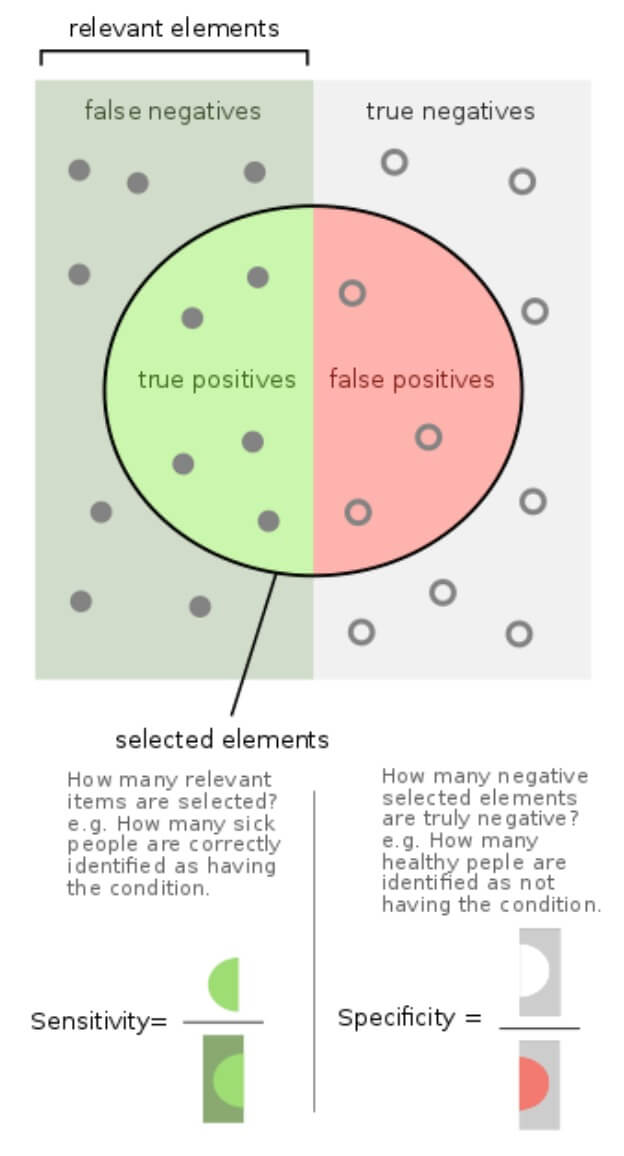
In epidemiologists’ talk, sensitivity refers to the
portion of positive cases who were correctly
identified as such, or the TPR (True-Positive-Rate).
On the other hand, specificity refers to the portion
of negative cases that were correctly identified as
such or the TNR. (True-Negative-Ratio). Both terms are
shown in figure #1.
During a study conducted in
The Solution
Deep learning is a form of machine learning inspired by
the human brain, where artificial neural networks use
gigantic amounts of data to learn how to do a specific
task by repeating it countless times, slightly optimizing
itself every time until it masters that task
Challenges & Conclusion
Although both of the frameworks discussed above are very
promising, they are currently undermined by many
challenges, the biggest of which is lack of data; Thus, AI
systems need billions upon billions of bytes for training,
and in this context, data must be acquired through
expanded testing and CT scans, most of which as of yet
have come from Chinese hospitals which implies the
possibility of selection bias
References
Solar Energy: In-depth review of solar cells
Abstract The Earth receives an incredible supply of solar energy. The sun, an average star, is a fusion reactor that has been burning over 4 billion years. It provides enough energy in one minute to supply the world's energy needs for one year. In a single day, it provides more energy than our current population would consume in 27 years. In fact, "The amount of solar radiation striking the earth over three days is equivalent to the energy stored in all fossil energy sources." Solar energy is a free, inexhaustible resource, yet harnessing it is a relatively new idea. Considering that the first practical solar cells were made less than 30 years ago, we have come a long way. A solar cell, or photovoltaic cell, is an electrical device that converts the energy of light directly into electricity by the photovoltaic effect, which is a physical and chemical phenomenon. It is a form of photoelectric cell, defined as a device whose electrical characteristics, such as current, voltage, or resistance, vary when exposed to light. In this article, types of solar cells will be studied and their various applications.
Amorphous silicon (a-Si) solar cells
Amorphous silicon (a-Si) is the non-crystalline form of
silicon. It is the most improved type of thin-film
technology that has been released in the last 15 years.
The manufacture of amorphous silicon photovoltaic cells is
based on plasma-enhanced chemical vapor deposition
(PECVD), which can be used to produce silicon thin film.
The substrate can be made of flexible and inexpensive
material. It can also be at low temperature that allows
the deposition on plastic as well.
“In its simplest form, the cell structure has a single
sequence of p-i-n layers.” Single layers could suffer from
significant degradation in their power output. The
mechanism of the degradation is called Staeble Wroski
Effect that refers to the light-induced metastable changes
in the properties of the hydrogenated amorphous silicon.
As the defect in the density of hydrogenated amorphous
silicon increases with high exposure causing an increase
in recombination current and reducing the efficiency of
the conversion of sunlight into electricity. In addition,
to solve this problem, it is better to use multiple thin
layers instead of one in order to increase the electric
field strength across the material.
One of the pioneers of developing solar cells using
amorphous silicon is Uni-Solar
Concentrated PV Cell (CVP and HCVP) following the sun
A Concentrating electrical phenomenon (CPV) system
converts light-weight energy into current within the same
approach that typical electrical phenomenon technology
well but uses a sophisticated optical system to focus an
outsized space of sunlight onto every cell for optimum
potency as shown in figure #1. Different CPV styles exist,
generally differentiated by the concentration issue, like
low-concentration (LCPV) and high concentration (HCPV).
Concentrator photovoltaics’ (CPV) could be an electrical
phenomenon technology that generates electricity from
daylight
Contrary to standard electrical phenomenon systems,
it uses lenses and mirrors to focus daylight, but
extremely economical, multi-junction (MJ) star cells
as shown in figure 1. Furthermore, CPV systems
typically use star trackers and sometimes a cooling
system to any increase their efficiency

Current analysis and development are rapidly rising their
fight within the utility-scale segment and in areas of
high solar insulation. CPV technology has been around
since the 70s. Recent technological advancements have
enabled CPV to succeed in viability with ancient fuel
plants, such as coal, gas, and oil, once put in regions of
the world with sunny and dry climates. Concentrating
photovoltaic systems work by changing sunlight into
electricity past upside solar modules think about constant
basic conception to come up with electricity
References
Link copied to clipboard!